
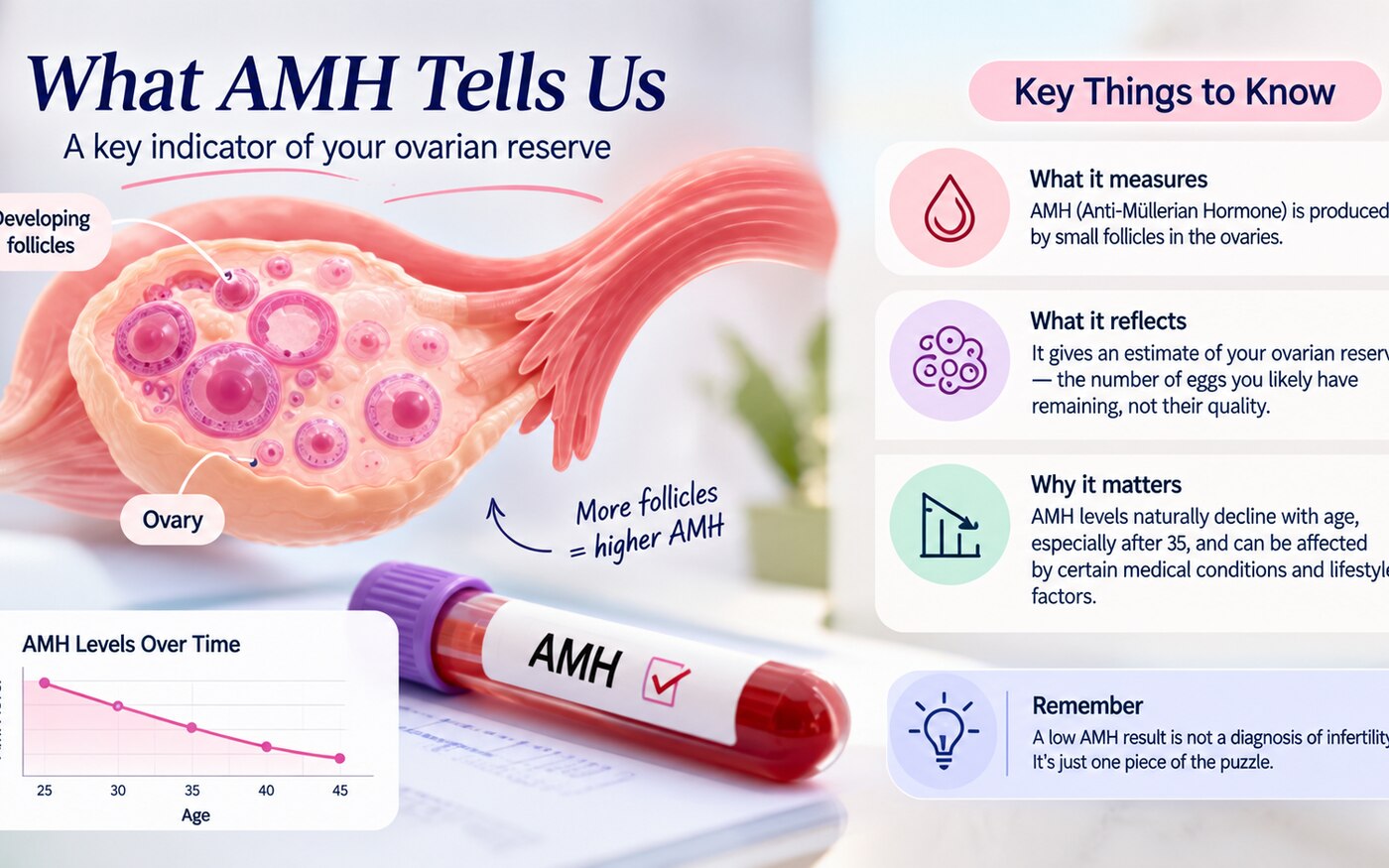
There's a particular kind of fear that comes with opening a lab result portal and seeing a number next to "AMH" that's lower than you expected. In the seconds after, your mind can race through worst-case scenarios: Am I already too late? Will I ever be able to have children? Before you spiral, it helps to understand what this number actually represents — and just as importantly, what it doesn't. A low AMH result is not a diagnosis of infertility. It's one data point about your ovarian reserve, and on its own, it tells only part of your fertility story.
Anti-Müllerian Hormone (AMH) is produced by the small, developing follicles in your ovaries. Its level in your blood gives doctors an estimate of your ovarian reserve — essentially, how many eggs you likely have remaining, not how healthy or genetically "good" those eggs are. Every woman is born with a finite number of eggs, and that number declines steadily over a lifetime, more sharply in the decade before menopause. AMH gives a snapshot of where you are on that timeline, but it's a quantity marker, not a quality one.
Here's what often gets lost in the anxiety of the moment: many women with lower-than-average AMH levels go on to conceive naturally, sometimes with a bit more patience, and sometimes with extra attention paid to timing and overall reproductive health. AMH is just one marker among several that matter for fertility. Regular ovulation, a healthy uterine lining, balanced hormones, and the general health of your reproductive system all play meaningful roles too — a woman with moderate AMH but excellent cycle regularity may have an easier path than the number alone would suggest.
AMH is most useful in context, not in isolation. Combined with other markers like antral follicle count (seen on ultrasound) and your age, it helps doctors form a more complete picture — particularly useful if you're considering fertility treatments like IVF, where it can help predict how your ovaries might respond to stimulation medications. For women trying to conceive naturally, it's more of a general guidepost than a verdict.
AMH is a simple blood draw. Unlike many hormone tests, it can usually be done on any day of your cycle, because AMH stays fairly steady from week to week. A few things can still affect how you read the number:
Here is something many women find comforting. Medical groups such as ACOG note that AMH is not a good test for predicting your chance of getting pregnant naturally in the near future. You only need one egg to be released each month. As long as you are ovulating, a lower reserve doesn't stop that from happening.
Where low AMH does matter is timing. It can be a gentle nudge not to put off your plans for too long, and to ask for help sooner if pregnancy isn't happening. Tracking your cycle can help you make the most of each month. Our ovulation calculator guide is a simple place to start.
Rather than fixating on a number you can't change, many women use a lower-than-expected AMH result as motivation to strengthen the fundamentals that are within their control: supporting hormonal balance, maintaining regular ovulation, eating in a way that supports egg health, managing stress, and giving their body the nutritional foundation it needs. This is the everyday role products like AGO Mom are designed to play — supporting hormonal balance and reproductive health as a foundation for your fertility journey, alongside whatever medical guidance you and your doctor decide is right for you.
Message AGO Fertility Care and share where you are in your journey. We'll listen, help you make sense of what it may mean for you, and suggest a personalized care plan suited to your situation.
Chat With AGO on WhatsApp